Round dents clustered on ridge caps or turtle vents
Round dents clustered on the ridge cap or a turtle vent hood usually mean hail struck that side of the roof; check the opposite slope's gutters for matching dings from the same storm.
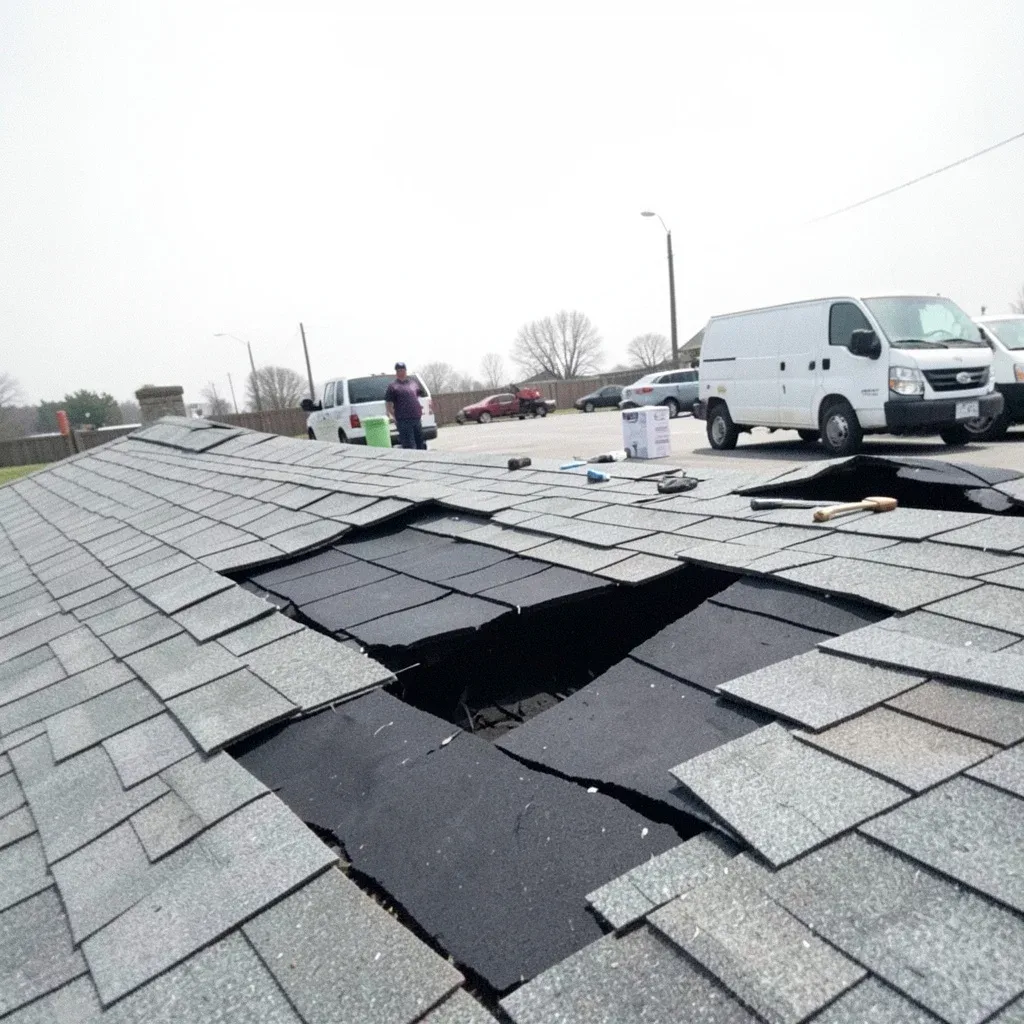
Hail concentrated in the April-to-June window is when most Omaha vent damage happens; freeze-thaw cycling through the following winter is what turns a cosmetic dent into a cracked, leaking seam.
Hail-dented roof vents and caps are metal exhaust or ridge caps punched with small round dents by hailstones. Look for dimples on the vent hood or ridge cap metal, matching dings on gutters, and check the attic for daylight around the pipe boot or vent base.
Wind rarely tears a whole roof off at once. It works one tab loose, then another, and water finds that gap on the next rain. Omaha homeowners often notice the leak indoors weeks before they'd have spotted the lifted shingle outside.
Round dents clustered on the ridge cap or a turtle vent hood usually mean hail struck that side of the roof; check the opposite slope's gutters for matching dings from the same storm.
Paint knocked off the rim of a dent is what separates a fresh hail strike from an old one. Weathered damage dulls and oxidizes; a recent hit shows bright metal or a clean break in the coating. Adjusters look at exactly this, so photograph the chipped edge close up and note the date of the storm.
A vent knocked hard enough to dent has usually been moved on its base, and the sealant around the flange is what fails when that happens. The resulting gap is small and it faces upward, which is the worst possible orientation. It is a cheap thing to reseal and an expensive thing to ignore through a winter.
Dents in the soft metal around the house corroborate what is on the roof. Gutters, downspouts, gutter aprons and air-conditioner fins all mark at a smaller stone size than shingles bruise at, so they are the first place to look and the easiest to photograph. Matching damage on several establishes that the storm was serious.
A stain on the framing beside a vent, rather than out on an open slope, points at the penetration. Every vent, pipe and fan opening is a hole in the roof depending on its flashing and sealant, and hail is what breaks those first. Trace upward from the stain and the entry point is normally within a foot of it.
Roof vents and caps sit higher and more exposed than the shingle field around them, so hail strikes them at a steeper angle and dents the thin metal before it marks the decking below.
Older vent caps in neighborhoods like Dundee and Benson often use thinner aluminum than newer builds in Elkhorn or Millard, which dents more easily under the same hailstorm.
An honest Omaha reroof estimate breaks out removal, deck repair, underlayment and haul-away as their own costs, so nothing gets folded into a vague total later. Ask how the price would change if rotten decking turns up once the old shingles come off, since that is a common surprise, not a rare one.
Hail-dented vents and caps get confused with granule loss on the shingle field nearby, since both come from the same storm. The test is location and material: dents show as round dimples in metal, while granule loss shows as bald spots on the asphalt shingle mat itself, not on any vent.
A dented vent with no split metal can sometimes be resealed at the base, but a cap with cracked seams or a broken pipe boot collar needs full replacement to stop water from tracking into the attic.
Repainting a dented cap only hides the damage; it does not restore the metal's shape or reseal a hairline crack that formed at the dent's edge.
Older homes carry original roofing that's outlasted its warranty even if it looks fine, while newer builds sometimes have shortcuts from a fast construction schedule. Neither age nor newness tells the whole story. The licensed pros we connect you with base a recommendation on what the roof itself shows, not on the year the house was built.
| Roof Condition Now | Costs More Later |
|---|---|
| Small openings do more damage than big ones over time. Nail heads, vent boots, and the seams around anything mounted on the roof loosen gradually under repeated freezing and thawing, letting moisture work its way in long before anyone notices a problem indoors. | Spring hail is the claim most Omaha roofs file, but wind gets less credit than it deserves. A gust that lifts one shingle tab lets the next storm's rain track sideways under the row above it, and that damage sits invisible in the attic for months before a ceiling stain shows it. |
| Hail season here runs concentrated and fast, not spread out over months. A single spring storm can bruise or crack shingles across an entire roof in minutes, and the damage is often invisible from the ground until someone gets up close. | A roof and an insurance claim don't always agree on what happened. Wind can lift shingles without a single one going missing, and hail can bruise a mat without cracking it visibly. Getting a straight answer on which is which matters more than getting a fast one. |
| Roof wear here rarely announces itself. Temperature swings through the seasons flex shingles and flashing, loosening seals a little more each cycle. By the time a ceiling stain or a soft spot shows up, the underlying damage has usually been building for a while. A yearly look from the ground catches problems before they turn into a bigger repair bill. | A roof carries snow load, wind uplift, and hail impact in the same year, sometimes the same week. Each stresses the roof differently, and damage from one often hides the damage from another until an inspection separates them out. That's why a walk-through after any rough season matters. |
Binoculars from the yard can spot obvious dents on a turtle vent or ridge cap. Checking the sealant around the base, the pipe boot collar, and the underside for cracking is roof-access work best left to the licensed pros we connect you with.
A cracked vent cap lets water reach the decking around the penetration, and repeated wetting can lead to rot and mold in attic framing near that spot before any ceiling stain ever shows up.
A guide figure for hail-dented roof vents and caps locally is an estimated $900 to $7500, which is a band rather than a quote. Omaha's freeze-thaw cycling, not insect activity, drives most hidden roof damage found around Dundee and Benson. The eastern subterranean termite is the local species, entering through soil contact, but it rarely factors into a reroof estimate here. The licensed pros we connect you with usually flag ice-dam and flashing wear before pest damage. pricing guide, and the service that handles this is Storm & Wind Damage Roof Repair.
Storm and Wind Damage. Wind-creased and torn shingles are shingles bent along a fold line by wind pressure, then torn at that fold by a later gust, usually on an exposed slope or rake edge.
Roof Defects. An ice dam is a ridge of refrozen meltwater along the eave, formed when attic heat melts upper-roof snow that refreezes at the cold overhang.
Roof Defects. Chimney crown and counterflashing leaks are cracks in the concrete cap or gaps where flashing meets brick, letting water into the chimney chase.
A single dented vent cap without cracks often runs a modest repair cost, while a full set of dented caps across a roof after a spring hailstorm costs more, since each one needs removal and resealing or replacement at the ridge or penetration.
Not always. A shallow dent with intact paint and no crack can sometimes wait for a scheduled repair, but any dent with chipped paint or a gap at the base should be checked before the next rain reaches the decking.
Insurers typically cover hail-dented vents and caps as part of a roof damage claim when documented alongside other hail marks like gutter dents, following Nebraska's post-loss assignment rules if a contractor is involved in the claim.
Yes, if it's cracked or split rather than just dimpled. A cracked vent cap won't reseal reliably even with new sealant, and matching an old cap's profile gets harder the longer a mismatched patch sits exposed to Omaha's freeze-thaw swings.
Gutters get treated as an afterthought until a basement takes on water. Roof drainage and foundation dryness are the same problem viewed from two floors, and undersized or clogged gutters push that water somewhere it was never supposed to go. Sizing them for how hard it actually rains here, not how it usually rains, is the part people skip.
Call (833) 566-1459