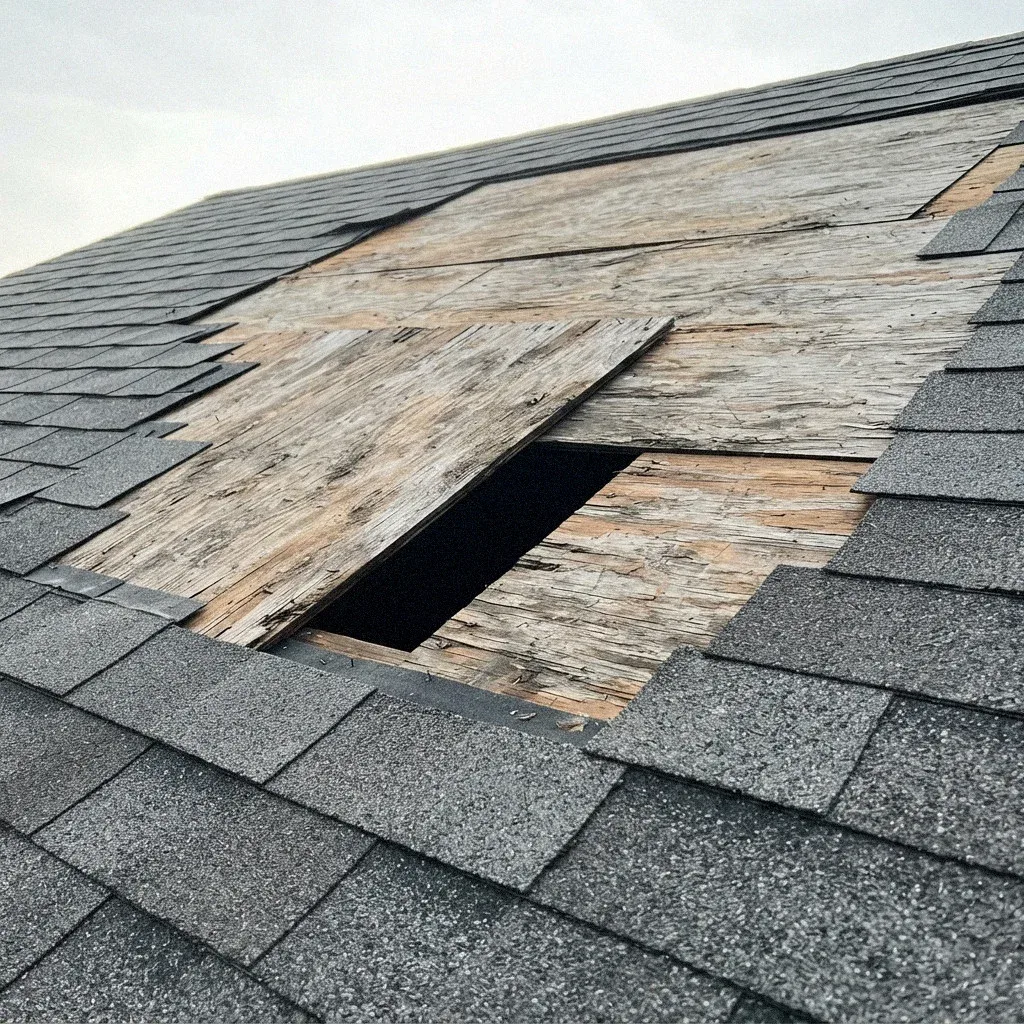
Rotted Deck Boards Found Mid Tear-Off in Omaha, NE
Weak roof decking caught mid-tear-off, replaced before the new roof goes down.
Across Douglas County, whether you're in Papillion, Elkhorn, Downtown Omaha, or elsewhere around Omaha, roof decking & sheathing repair is worth arranging with somebody who works on this housing stock rather than a generic plan. Foundation type, soil and building age all change what has to happen first.
Houses and businesses both get this treatment, but the scheduling differs. Compare residential roofing with commercial roofing and pick whichever fits the property.
Signs You May Need Roof Decking & Sheathing Repair
Soft, Spongy Roof Underfoot
Step across the roof plane and feel for a mushy, trampoline-like give under your boots, most often near a valley or an old vent boot in Dundee or Benson. That flex means the sheathing panel under the shingles has lost its stiffness. Spongy decking rarely announces itself any other way until someone's foot finds it, which is why a walk-through before tear-off catches problems an eye-level look from the ground never will.
Sag Running Between Rafters
A sag that follows the bays between rafters, rather than dipping at one point, is the sheathing itself giving way. Each sheet spans from one rafter to the next, so when the wood softens it settles in those spans and the roof reads as gently rippled from the street. It is a different problem from a sagging ridge, and it is the more common of the two here.
Dark Rings on Attic Boards
Pull back attic insulation where a stain trails down from the roof deck and press the wood itself. Delamination shows up as layers separating or peeling apart at the edges of a sheathing panel, and dry rot leaves the wood gray and crumbly enough to push a thumb through. Both can sit above insulation for years in a Millard or Elkhorn attic without anyone noticing, since the shingles above still look fine from the yard.
Our Roof Decking & Sheathing Repair Process
Old Covering Comes Off First
Decking cannot be judged with a roof on top of it. The covering comes off in sections so the wood can be walked and sounded, which is the only reliable way to find a sheet that has softened. It is also why a layover hides problems: new shingles over old leave whatever is underneath exactly as it was.
Roof Decking & Sheathing Repair in Omaha
Roofs here move a great deal, because the swing between a July afternoon and a January night is wide and the wood expands and contracts with it. That movement is what backs fasteners out and works at the joints between sheets. Decking in this climate fails at the edges and the seams far more often than in the middle.
Soft Wood Cut Back Clean
Soft wood is cut back to sound material and to a rafter, not patched over. A sheet is only as strong as what its edges land on, so a piece let in between supports will flex and fail again. The cut lines follow the framing, which is why a small soft patch sometimes means replacing a whole sheet.
New Sheets Nailed to Rafters
Replacement sheets are matched in thickness to what is already there, gapped to allow for movement, and nailed into the rafters rather than into the sheet beside them. Getting the thickness wrong leaves a step that shows through the finished roof. The per-sheet rate should have been on the estimate before any of this began.
Why this matters
Omaha's older neighborhoods, including Dundee, Benson, and Florence, carry roof decks that have gone through decades of freeze-thaw cycling and hail seasons without the panels ever being seen. A leak or an ice dam can sit above the insulation working on the wood long before a stain reaches the ceiling below, so decking condition stays a guess until the shingles come off.
Code-Compliant Roof Decking & Sheathing Repair in Nebraska
One Permit Covers the Deck
Where a reroof needs a permit from the City Planning Department, the decking work is part of that same permit rather than a separate application. That matters practically: the decking cannot be assessed until the covering is off, so the scope may grow after the permit is issued. The per-sheet rate belongs on the estimate from the start for exactly that reason.
Plywood Versus OSB Panels
What sits under an older Omaha roof depends on the era it went up. Plywood or oriented strand board panels are typical on homes reroofed in recent decades, while skip sheathing, individual boards spaced with gaps between them, turns up under older shake roofs in neighborhoods like Dundee or Field Club that were later covered over with composition shingles. Replacement panels get matched to whichever type and thickness is already on the rafters.
Roof Decking & Sheathing Repair: Estimated Cost by Job Size
Ballpark pricing for roof decking & sheathing repair around Omaha. Nothing is charged until you have a written estimate in hand.
| Roof Deck Condition | Attic Ventilation | Project Schedule |
|---|---|---|
| Two separate warranties come with most reroofs: one from the manufacturer covering defective shingles, another from the contractor covering their own labor. Knowing which one applies to a given problem saves an argument later about who is actually responsible for the fix. | Full roof walk with attic check for daylight or damp decking | an estimated $420–$4275 |
| Labor warranty terms vary widely between contractors, and the gap shows up when a leak appears well after the crew is gone. Ask what specific timeframe covers labor versus materials, and get the answer written into the contract itself. A verbal promise settles nothing once the job is finished and paid for. | Tear-off, new underlayment, standard shingle color, haul-off included | an estimated $600–$5850 |
| A manufacturer's shingle warranty typically depends on the installation meeting their specifications. Skip a required detail during the job, and coverage can be denied later even though the shingles themselves were never the problem, leaving the homeowner to cover a repair that should have been free. | Reroof with valleys rebuilt, ridge vent added, permit filing included | an estimated $780–$8100 |
| Get warranty terms in writing before any work begins, spelling out what is covered, for how long, and by whom. A spoken assurance rarely survives a disagreement about which layer failed and whose responsibility it was to catch it beforehand. | Large reroof, skylight flashing rebuilt, no drywall or paint work | an estimated $1080–$11700 |
Materials sitting on a driveway for weeks before work starts is normal scheduling, not a red flag by itself. A delivery with no signed contract or permit behind it yet is the thing worth asking about.
Frequently Asked Questions
Can you tell my decking is bad before tear-off?
Only partly. A soft spot underfoot or a sag between rafters seen from the attic points to trouble, and staining on the underside of the deck backs that up. But the full sheet count involved, how far the rot has spread past what's visible, stays unknown until the shingles come off and the licensed pros we connect you with can check each panel by hand.
The last inspection missed rotten decking. How?
A roof inspection typically covers the shingles, flashing, and whatever attic framing is visible from the floor, not the sheathing panels sealed under intact shingles. Dry rot from a slow leak or trapped moisture can spread across a deck for a year or more without ever reaching the surface, so a clean inspection report doesn't rule out a soft or delaminated panel underneath.
How much does it cost to fix bad decking?
There's no way to price it exactly before the tear-off starts. Once the old shingles are stripped, the licensed pros we connect you with count how many sheets of decking are soft, delaminated, or rotted at the rafters and price the repair per panel. A repair localized to one slope costs far less than rot that turns out to run across multiple sections of the deck.
Will you replace only the bad sheets, not the whole deck?
Yes. Sound sheets stay. What gets replaced is anything soft, delaminated or rotted, cut back to a rafter so the new piece lands on framing rather than floating between supports. That is why a small soft patch sometimes means a full sheet: the cut lines follow the structure. The per-sheet rate should be on your estimate before the tear-off begins.
Is my roof plywood, OSB, or older skip sheathing?
Plywood and oriented strand board are the panel materials used under most composition shingle roofs in Omaha today. Skip sheathing is different: individual boards nailed across the rafters with gaps between them instead of one continuous sheet, common under older cedar shake roofs in neighborhoods like Dundee before they were converted to composition shingles. Each type gets repaired with matching material, not swapped for the other.
Does a rotted deck need its own separate permit?
It falls under the same roofing permit the City of Omaha Planning Department already requires for the reroof, not a separate filing. There's no confirmed exemption threshold published by the city for small sheathing repairs, so decking work found during tear-off gets folded into the permit already pulled for replacing the covering.
How much does roof decking & sheathing repair cost in Omaha?
A roof rarely fails on the first bad storm. Freeze-thaw cycling opens seams over several winters, hail bruises shingles that keep shedding water for another year, and wind lifts the same edge until it finally gives. Age and prior repairs shape when a small problem turns into water on the ceiling.
Related Services & Areas
Ready To Get It Fixed
A homeowner near Aksarben Village or out toward Elkhorn is dealing with a specific roof, not a general one, so the details on this page are a starting point rather than the final word. Age, slope, and how the last hailstorm hit matter more than any single description can capture. From here, the licensed pros we connect with can look at what is actually happening and say what it needs.
Call (833) 566-1459